
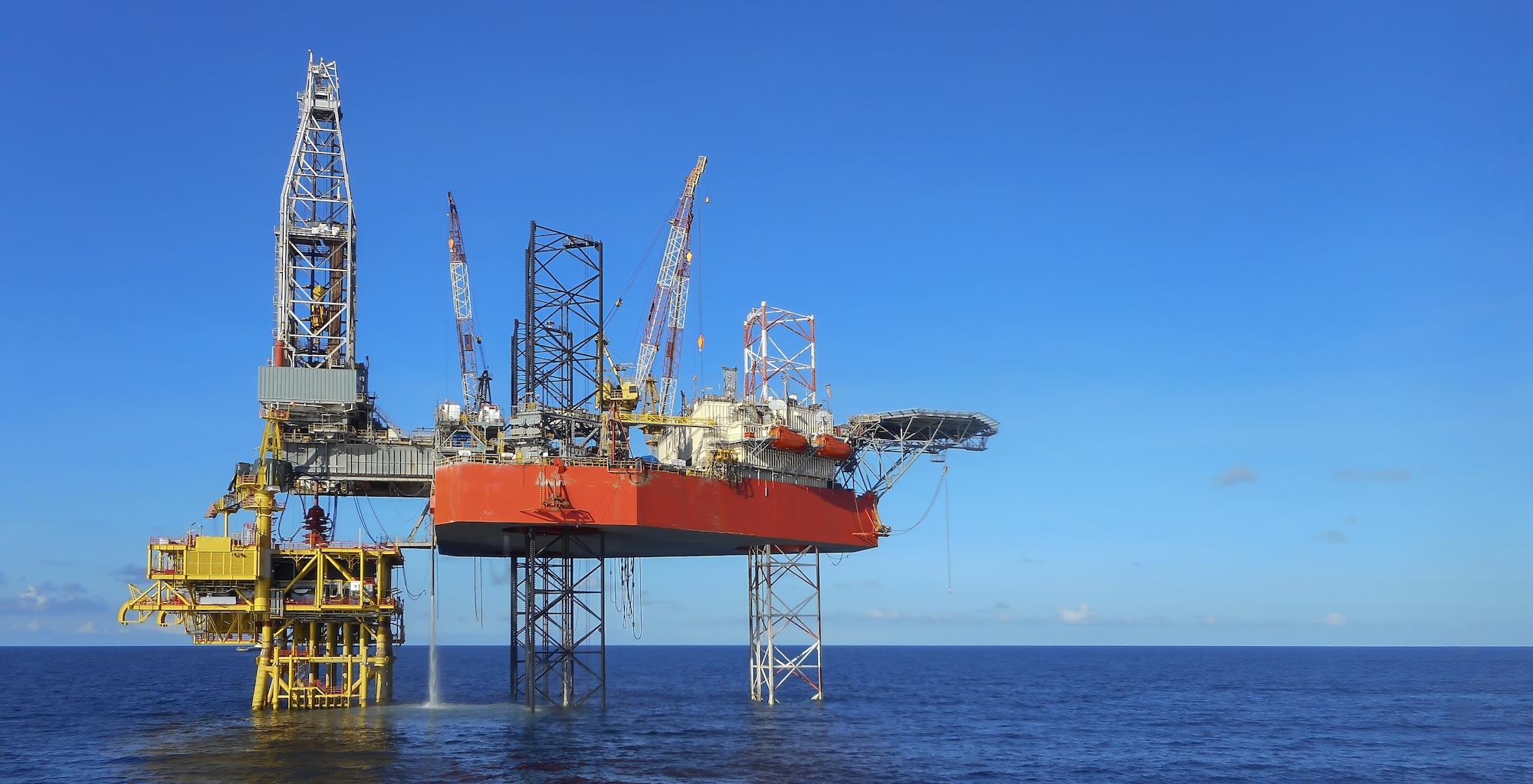
Jackup Riser System Analysis
Jackup Riser Analysis has been carried out by AS Mosley on multiple Jackup Riser Systems. Our assessments are used to understand and predict the performance of Jackup Riser Systems, under varying environmental conditions and operational loads. This helps to assess the structural integrity of the riser system and determine limits for operations and fatigue life.
Structural Load Analysis is performed to evaluate the mechanical stress of the system, and how it responds to tension, bending, compression, and torsion during extreme environmental conditions. This is carried out for a fully pressurised riser, where applicable, and accounts for a loss of tension event. The results of the assessment are used to evaluate the suitability of the system for the planned operation and provide feedback for optimisation of the design or operation where necessary. Fatigue assessment is also performed for both wave and current loads (VIV) to determine the life span of the riser system and the impact it has on the wellhead/conductor system it is connected to.
Modelling is carried out using Orcaflex, a global riser analysis package. Using this software, a global riser model is generated from the sub mudline conductor up to the surface control equipment. This includes a soil model and appropriate constraints at the Jack-up deck elevations Hydrodynamic loads are applied from the wave and current action with Jack-up motions included in response to the same environmental forces.
The Outcome
Jackup Riser Analysis gives operators the data they need to make informed decisions, which in turn ensures optimum design, prevents damage, and maximises operability.
For more information on our Jackup Riser System Analysis, please get in touch.
History of Jack-up Riser Systems
Jack-up drilling rigs have a fascinating history tied to the evolution of offshore oil and gas drilling. These rigs are mobile platforms used to drill in shallow waters and were designed (initially 1954) to be raised above the water level using legs that are extended down to the seabed. Modern Jack-ups can now comfortably drill in 120m (394ft) water depth and in some cases extend to a maximum water depth of 150m (500ft).
The Jack-up rigs were historically used to drill exploration and appraisal wells installed using 30” conductor with all casing supported on top of the conductor at surface. In the early days there was no provision for installing subsea wellheads and Trees and surface technology was fully employed. Developments were made in mudline suspension systems so that wells could be predrilled using the jack-up and then tied-back through a newly installed platform to the suspended mudline system – for long term production.
Further developments were made to install subsea wellheads and trees using a Jack-up. The subsea wells were installed with ‘Tree on Mudline’ wellheads using old style 13 5/8” housings which could be run through the 16” HP risers from the Jack-up. The subsea Trees were then installed on the wellheads using a 7” workover risers to run the Tree, complete the wells and start production.
Modern 18 3/4” subsea wellheads could not be installed from a Jack-up until the relatively recent introduction of the 24” HP riser. The 24” HP riser can accommodate the larger 18 ¾” wellhead housings. This development has opened up the scope for Jack-up rigs which are now competing with semi-submersibles for shallow water work.
Combinations of all of these riser systems are still used and AS Mosley regularly performs analysis to improve the design and sustainability of the Jack-up systems.
For more information, contact us directly.
FAQs:
A Jackup rig is a mobile drilling platforms that has extendable legs and can be “jacked up” above the surface to provide a stable drilling platform in shallow waters.
A Jackup Riser System is predominately used on Jackup rigs. The system serves as a conduit, connecting the wellhead on the seafloor to the Jackup rig. The Riser System facilitates containment of the drilling fluids, well control, and in some cases production fluids.
Unlike the riser systems used on floating rigs (e.g. semi-submersibles or drillships), which are designed for deeper waters, jackup risers operate in shallow water (up to around 400 feet, or 120 meters). The legs of the jackup rig reach the seabed, providing a fixed point of support and reducing the range of movement, which allows for a simpler riser.
A Jackup rig is a mobile drilling platforms that has extendable legs and can be “jacked up” above the surface to provide a stable drilling platform in shallow waters.
A Jackup Riser System is predominately used on Jackup rigs. The system serves as a conduit, connecting the wellhead on the seafloor to the Jackup rig. The Riser System facilitates containment of the drilling fluids, well control, and in some cases production fluids.
Unlike the riser systems used on floating rigs (e.g. semi-submersibles or drillships), which are designed for deeper waters, jackup risers operate in shallow water (up to around 400 feet, or 120 meters). The legs of the jackup rig reach the seabed, providing a fixed point of support and reducing the range of movement, which allows for a simpler riser.